Follow on Twitter

Friday, 23 July 2010

Double-Dip, Deflation, or Recovery
The present times are probably critical for more than one reason. Every generation believes that they live in unique times. At the turn of the year, when I was confident that we are heading into deflationary times, I was considered to be part of the lunatic fringe. It was conventional wisdom of the market participants that there was a less than two percent chance of a double dip recession in the USA and that the largest economy in the world would grow at more than 3.5%. Some were even forecasting 4.5% GDP growth for the USA. Seven months down the line and just two months of bad economic news seems to have made most of them run for cover. ‘Double dip’ is back in the popular lexicon and probably the topic of hushed conversations in parties (which I am sure have declined in their ostentation, though it would be sacrilege to even mention that this is a consequence of the credit crisis). It would be pertinent to ask would these deflationary pressures accentuate this year and are we heading into a collapse in the economy (like in 2008)? Once again, the answers are very tricky and by the time this note is complete I would end with more questions than answers. I will try to avoid providing empirical data as that is mostly available and there have been enough occasions where I have provided forward various news items.

On a very personal note, 2010 has unfolded more in sync with my thinking as elucidated in my period updates about the economy. Despite all the pessimism about the economies of the Western World, I am bit more optimistic than the most recent ardent bulls turned confused-bulls. But that could probably be due to the fact that I have been so bearish for such a long time that it may feel like up to me. However, I am outright bearish on the real economies of India and China. This is not to mean that I expect both of them to collapse. Unfortunately for both these countries they don’t have to have a recession before their people feel like a recession. In the case of India, the Ministry of Labour estimates that nearly 20 million people will join the work force from 2010-15, therefore unless the economy grows at more than 6% the country will face greater problems. Similar problems exist in India. Thus most of the emerging markets have to run faster just to remain at the same place. Is that possible? Theoretically possible, practically a herculean task. I would be watching China very closely, not because I believe like the rest of the crowd because it could lead us out of the mess, but because it would probably be the answer to the question: are we heading into a depression?
It was conventional belief (at least for me) that one year was a short-time when it comes to the working of the real economy (not the financial markets). The markets as well as the economy have literally been on a roller coaster over the past two years and probably continue to be so over the next five years (a validation of the Japan chart that I had sent about a year ago). As a researcher what interests me is the tussle we have among the bulls and the bears. These usually occur either at market tops or market bottoms. Reading the Indian newspapers gives me the eerie feeling that it is 2008 Déjà vu allover again. We have estimates that the Sensex will reach 22,000 over the next few months, new range bound Sensex: 17000 to 22600 (I wonder how they could conjure up the 22,600: probably a technical target). The list goes on. In other words, anybody dissenter is senile (at best) or positively mad (at worst). I often wonder which category I fall into.

Unconventionally, I will start with the good news. The Credit Spreads have settled down from their panic that was indicated in their late April surge which caught most of the people unawares (not us by the way). However, this is not to claim that the panic is over. The decline in the credit spreads may simply mean a breather, just as we had in 2008. Moroever, with the stress tests due on 23 July 2010, the celebrations may be too premature.

What I am probably more excited (again, may be too premature) is the Helicopter Ben is now more amenable to increasing the money supply. The last two weeks have been critical as after a long time, the Fed has increased not only stopped draining money from the system, but has instead marginally increased it. Since Bernanke is a scholar (and an excellent one, unlike Greenspan) of the Great Depression, he may be able to stave it off – but only this one time.

Another piece of good news is that unlikely 2008, the US and the Japanese corporate sector has cash on its balance sheet, implying that their survival is not at stake over the next one year, unless something goes wrong horribly. I am beginning to wonder why companies were not willing to spend for such a long time? Probably, they have stopped believing the Equity markets and instead prefer to hoard cash. Take the case of the banks. They prefer to buy US Treasuries.

An analyst had a great idea: the banks should be forced to lend and that way they will put money back into the system. He also accused the Fed of not doing enough and instead claimed that the Fed was encouraging the banks not to lend as it was paying an interest on the funds parked by banks with the Fed. I would not be so critical of the Fed and would instead think that the analyst suffers from intellectual poverty. I think if there is any institution that knows the scale and magnitude of the problems, it is the US Fed. They are trying their best to let the banks earn their way back to profits so that they it reduces the need for more bailout funds, which may not be so easy to come by.
The following chart (non US Government securities investments) clearly shows that the balance sheets of the banks continue to be stressed). They are not investing and are instead still busy rectifying their balance sheets. This is probably because their capital hole is too big to be filled in a short-time. A recent New York Times article stated that the banks worldwide need to repay bonds and other debt obligations to the tune of about US$5 trillions of debt due through 2012.

Hence, their unwillingness to invest in any assets, expect the most liquid asset (the US Treasury bond) after the collapse of the securitization market augurs ill for the world economy.

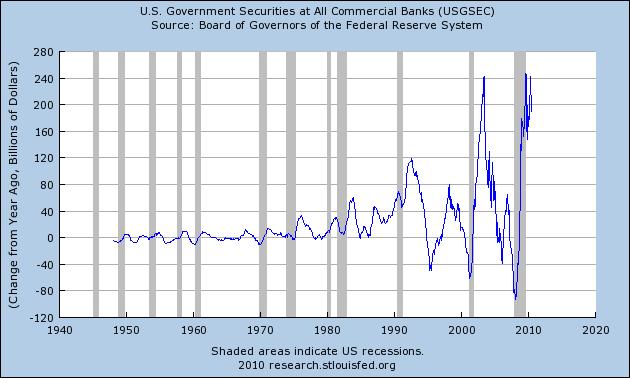
The chart below provides an overview of the US Government securities owned by Commercial banks in USA. While that could provide some capital cushion in the short-term, I believe that in the long-term that is insufficient for the simple reason that the bad loans on the books far exceed their assets. David Rosenberg has pointed out that the US banks have a second-lien exposure on housing mortgages to the tune of nearly US$850 billion. These assets are marked at par by value in their books, surprisingly high considering that housing is on the verge of another sharp downmove.
Consumer credit continues to collapse on a scale that is similar to the levels not seen since the Great Depression. The chart below shows the magnitude of the debt deleveraging that the US is

is passing through.

Double Dip or Continuation of the Recession

The dating of the recessions (officially) at least in the USA is the task of the Business Council Dating Committee of the National Bureau of Economic Research (NBER). To the best of my knowledge, they have not called an official end to this recession as yet, though they may announce it by back dating it. So officially the USA is still in one. I am sure nearly 18 million partly employed or unemployed may actually feel it is more akin to a Depression rather than a recession. Interestingly, even the perma-bears are not willing to call a double-dip. A number of them actually believe it could be more like 2002 when we have a relapse but would actually avoid recover from the edge of the cliff. Unlike, 2002, the government’s (not just in USA, but all round the world) have less maneuvering space. Instead, the next phase of the panic is likely to be trigged by a government related issue.

I would be less sanguine and have a slightly different hypothesis, which I am now more inclined to believe. I believe there are a lot of factors that could go wrong. I would prefer to look at the economy and its possibilities of a recovery through the third angle, rather than in simple binaries: recovery or collapse in the near term. It is very likely we are heading into a period of periodic storms followed by huge rallies that would be due to technically oversold conditions that may be accompanied by bouts of misplaced optimism that the economy is about to recover.
What makes me so bearish? Top on the list is the fact that the world has not solved any of the problems that led us into this mess in the first place. The crisis has basically made the consumption driven model of the past 35 years for the world economy, atop which our process of globalization was built more or less redundant. It based on a few consuming nations being supplied by low cost countries providing the goods and services – first Japan, followed by the South East Asian countries and now China: remember the flying geese pattern hypothesis for the world economy. This model could have become more sustainable if at each stage nations moved into a higher plane of economic activity, like providing high ended services while at the same time transforming their labour force to suit the needs. But that would have needed rapid technological breakthroughs at an interval of one a decade. Unfortunately, the history of technological change is that we usually have major technological breakthroughs taking place at a three decade interval. The shaky economic model would probably have been punctured by the turn of the last decade of last century, but the rise of the internet postponed matters, albeit for another few years. In the interregnum, in order to deal with cyclical problems that arose due to a down move in the business cycle our policy makers created ever larger bubbles in different sectors. While this story is well known and is oft repeated, the post 2008 reaction of the policy makers, especially in the past two years is shocking.

Obama’s attempts to solve some of the problems created by the financialisation have been shot down by his opponents. The mild measures that he had proposed were further watered down and it now unlikely that they will make any difference in taming the speculators round the world. Thus, the structural problems that the world faces have not only grown worse. We have not able solve any of the structural problems that have been brought to the forefront due to a redundant world economic developmental problem have not been dealt with. Instead the policy makers are attempting to solve the issue of indebtedness by taking on more debt. In the past we had a few institutions that were ‘too big to fail’. This list has now morphed into ‘exponentially large to fail’.

Welcome to the Era of Rotating Sovereign Crisis:
The downward spiral in the world economy, albeit at deterioration at varying speeds and intensity, has led to a common mistake, especially amongst the laity. They now mistake the crisis as a mere cyclical problem in a structural story that is intact rather than the other way round. The remarkable, lasting legacy of the crisis has been complacency or more like selective amnesia that pervades once there is rally in the markets. A recent article implied that a 8% rally in the Euro may mean that the Europe had already passed its biggest stress test. The ostensible reason for thinking seems to be that Greece, Spain and Portugal had raised about 50 billion Euros in debt, since the EU announced their US$1 trillion rescue fund. Investors may be better advised to note that the ECB has actually purchased bonds in excess of Euro 50 billion since the rescue package implying that foreign institutional investors may be keen to exit the Eurozone. All the three Club-Med countries (as PIIGS) are now referred to), have seen their interest costs shoot up by at least a percent. Greece borrows at more 10% for their 10 year bonds, while Germany borrows at 2.61%. At the beginning of the year, it was more like 6 and 3.5% respectively. More ominously, since March, none of the Southern European banks have been able to access the bond markets. Ironic, that we have so many ardent bulls even at this stage. Policy makers are indulging in pep talk rather in order to reduce the panic. They probably forget to that a problem exists not just in Southern Europe but also Eastern Europe.


We are yet to see the full fledged impact of most of the governments cutting spending in order to please the bond market. The bond market has already got what it wanted, reduced government spending means that the last vestiges of factors that may cause inflation are wiped out. All the indicators seem to indicate a fall in demand and collapse in pricing power. The question that we have to see is if we are about to witness a gradual decline or a precipitous fall. I would think that we are about to see a slow steady creeping in deflation over the next few years. I am wrong: we are not going to witness into a deflationary spiral this year. That is why I dread this type of collapse, a precipitous fall will also create the momentum for a rebound. A slow grinding fall would mean that it would be more difficult to combat inflation, more so because one part of the world (Emerging Markets) are grappling with their last bouts of inflationary spiral. The lag-effect is probably what we are witnessing. Producer prices continue to fall over a quarterly basis, loan demand has collapse (see Japan if you don’t believe me: down for five quarters), unemployment continues to grow, personal incomes are down, retailer have continued to see a collapse in margins: they now expanding the items available for discount.
There are other problems the US economy is undoubtedly slowing and it may tip over if there is no additional short-term stimulus. The economy has declined from about 5% in the last quarter of last year to about 2.7% last quarter (after downward revision). Interestingly, it has been pointed out that about 1.88% of the growth was due to inventory restocking, a process that is now not taking place. Thus we are likely to witness greater pressures on the economy, apart from the consumer, which comprises of about 70% of the economy. Add to this the problem that debt has not declined in the US and continues to be more than 120 percent (relative to disposable incomes). This is bound to rise as personal incomes decline in the country.

Positive views about European economies are largely a result of rear view mirror driving. The problems of Europe are just starting and they are likely to bite with greater intensity only in the next four quarters. Hungary has been through fiscal austerity since 2006 but has not been able to recover. Ireland is yet another case of what happens when we crash into a deflationary spiral – especially when the policy makers do not have any more effective tools.
Most of the Government’s desperately need money in order to repay their maturing debts. They face Hobson’s choice of whether to default on their debt obligations (which would be immediate death warrant) or take up draconian expenditure cuts and increased taxation while retrenching thousand or probably tens of thousands. The second set of measures would be political suicide and a recipe for social unrest, which is yet to start. There is a limit to the tolerance of those who suffer, especially when they are witness to the excess pay of the bankers and others whom they would view as being let off loosely. England would probably be the case that we would have to watch closely for clues about how this would play out. The government has vowed to reduce expenditure and they have imposed taxes in the budget that would force each household to pay at least 3000 pounds in either direct or indirect taxes – the largest squeeze since the 1970s. While till date these measures have been received with muted opposition due to the goodwill that exists for any new incoming government, it would probably be difficult to sustain further cuts and new taxes.

Optimism about a likely sustenance of economic momentum is likely to be dissolve quickly as the increased activity that we saw in the form of recovery of European exports are not due to increased demand but because they have turned out more competitive in the market place due to the collapse in the currency. Therefore it is likely that this short-term measure is likely to have resulted in EU companies having outbid their Chinese and US rivals, meaning that as long as demand is unlikely to pick up, European rebound is likely to be a zero sum game.

The only tool that the policy makers have is their ability to increase the supply of money. Bank of England and the US Federal Reserve are largely gearing up for this. The steep fall in the money supply (see chart) means that the impact of this will be felt over the next couple of months. We believe that the fall in the housing in the USA with additional signs of growth cooling in China will provide the trigger for the next step of easing from the US Fed.

However, we should not read too much into the intentions of the US Fed and the Bank of England to increase the money supply. The sheer magnitude of the requirements in order to simply rollover maturing debt would far exceed the increased supply of money. Banks in Europe need to rollover or repay nearly US$5 2.6 trillion of liabilities in the next three years, while banks in the USA need to refinance US$1.3 trillion through 2012.
Banks worldwide owe nearly $5 trillion to bondholders and other creditors that will come due through 2012, according to estimates by the Bank for International Settlements. About $2.6 trillion of the liabilities are in Europe. Bank of England has clearly stated that that the funding gap for the British banks would be a "substantial challenge" and points out that the amount that UK banks need to refinance by the end of 2012 at between £750bn and £800bn . Add to this the colossal sovereign and corporate debt and we will easily cross US$12 trillion. The inflation hawks fell allover themselves when the governments pumped in US$3 trillion or thereabouts. Imagine their reaction once the governments are forced to keep the money flowing. Unfortunately, this money needs to be created at a time when the world economies are cooling. Brazil has just been added to the long list of countries that are likely to witness a cooling of growth. Thus the fond hope of the optimists that the Emerging markets are likely to spearhead the world economic growth may not fructify. As long as the slowdown does not result in hard landing in the world economy, we may remain hopeful that the world economy may limp its way in circles.

There are a number of other indicators that are indicating that the world economy (and with it invariably the markets) are heading into unchartered waters. Among the indicators that need to be specially watched include:
(a) Baltic Dry index which has collapsed over the past two months. It is imperative to note that despite recent moves to dismiss the indicator, its direction has precedes the equity markets by about 3-4 months. Optimists should pray that it is wrong (at least this time. If the indicator were to be proved right then we could expect a precipitous fall in the equity markets in the next three months. From a purely technical point of view, the indicator will be able to avoid a new low only if it is able to sustain above 1500 (the close on 21st July 2010 was 1781).
(b) The Journal of Commerce Smoothed Average is yet another reliable indicator that is indicating trouble. The indicator consists of commodities that are exchange traded as well as those that are traded between actual users and those which donot have the presence of the financial speculators. The only other time that the index has crashed with such intensity was in the months before and after Lehman – a portent indicator of a sharp slowdown in the economic activity. I would speculate that Companies may be so weary that they may actually be shutting down capacity, which will be bad for the economy over the next two quarters but inventory restocking will simply lead to another bout of recovery in the manufacturing sector from March 2011.

Directional Call on the World Economy: Recovery or Deflation
Though over the next 2-3 year period I am more inclined to believe that deflation will be the predominant stress factor over the World economy, it will not take the centre stage during the rest of this year and early next year. However, the deflation scare will continue to become more pronounced (I hope I am not considered to be part of the lunatic fringe for this). My reasoning is rather simple. Bernanke had pointed out that the Fed can expand its balance sheet upto US$5 trillion without causing major strain in the public finances. Their balance sheet is under US$2 trillion. This would imply that while it could increase its balance sheet by another US$3 trillion, I believe it could reach another US$1 trillion in case of special circumstances, where the predominant fear would turn to economic growth rather than the present sovereign debt issues. That expansion in the balance sheet may be the catalyst that could avoid a deflation this year. But I am not so sure it would avoid it in the long run as the law of diminishing returns is far too advanced for the US to use further stimulus to create further growth. The ability to create GDP growth by pumping further stimulus has dramatically declined over the past few years. Moreover monetary policy takes time before its impact feeds into the system.

I place the possibility of a sustained recovery very low. However this is not to mean that the world economy will collapse. Instead I think the world economy is set for a prolonged phase of gradual decline (remember Japan) over the next few years with a period jumps that would largely be part of a cyclical upmove within a broader down turn. We have seen how long it could take (Japan) if there is no war (as in the case of the Second World War) to bring the economy from this self-perpetuating downward spiral.

Fleet footed, well-informed investors could benefit vastly over the next few years provided they raise that
(a) Opportunities will be global in nature.
(b) Capital would play a increasingly important role.
(c) Precise knowledge and analytical skills are required to rotate into and out of sectors.
(d) They realize that the new long-term would 2-3 months or at most 5 months.
(e) Markets would be driven by technical and news flow rather than fundamental in our new long-term.


As always, I hope my analysis is wrong as it would be far easy to earn money in a market that is uni-directional rather than what I expect.

Tuesday, 6 July 2010

The World is looking a lot like Japan
The complacency about the global economic recovery is gradually giving way to concern that the world economy may be able to relapse into another recession and even a depression. Infact the US and Western economies are looking a lot like Japan after its bubble burst in the early 1990s. Unless the policy makers think of solutions that may have to include default, this crisis will only be prolonged. Short-term quick-fix postponement of the solutions will only prolong the eventual pain and prolong the crisis. The World economy is in urgent need of long-term structural solutions but there is a clear lack of will power amonst the policy makers to undertake drastic reforms as they fear being branded 'anti-business'. Ironically, a 'pro-business' tag would mean a complete systematic siphoning off of public money to bailout speculators. I have reproduced some empirical data (shorne of any analytical inputs) in order to try and provide readers with a hope that they will be able to come to their own conclusions.

Problems in USA
A number of very important indicators are indicating troubling times ahead. The most important indications of problems ahead have once again come from the Bond markets and subsequently the commodity markets. The US Benchmark S&P 500 has lost nearly 16% from its 2010 high. The losses in the markets have largely been due to the fears that the deficit cutting may cause to the weak global economy that could dash all hopes for a recovery. It has been pointed out that globally governments have promised to cut nearly the equivalent of 2.5% of the world GDP. If the bond market is right, this could be a historical blunder.
All the important economic statistics released over the last two weeks are leading to concern replacing complacency as the dominant macro-economic theme. Concerns related to double-dip recession in the west or even an economic depression is coming to the forefront. Employment generation is still a distant dream in the USA. Unemployment claims actually increased to 472,000 as against the consensus estimate of 454,000 for the last week, while manufacturing in the USA slowed from 59.7 to 56.2, while the consensus was 58.9. Pending home sales collapsed by 30% (immediately after the expiry of US Government tax benefits, while the consensus expected it to fall by just 7.4%. The hope the private sector demand is turning out to be a mirage. The latest statistics from USA indicate that against the expected private sector job creation of 110,000 only 83,000 were created.

The yield on two-year US Treasuries has fallen to a record low of 0.61pc in a flight to safety, a level not seen during the depths of the Great Depression. Ten-year yields dropped below the psychologically sensitive level of 3pc to 2.96pc. Japan 10 year bond yields have reached a 7 year low of 1.06%, the same that they were when the government started its battle against deflation. Bond market sales by corporate dropped by 39% in the first six months of this year from last year’s level because of increased emphasis on safety rather than returns.

The US Housing 26 months of supply overhang – inventory of all kinds and the next big down move in the US housing sector has just begun. The housing sector cannot be helped due to the large debt overhang among the US and European households. In the USA, debt-fuelled demand during that last exponential surge in the credit cycle that took the household debt-to-GDP ratio from 100% in 2001, to the peak of 136% in 2008. That ratio has since come down, to 126%, but that suggests that the process of mean reversion will take more time. This ratio was closer to 30% at the end of the last secular credit collapse as we emerged from World War II.

Leading economic indicators are showing that the US economy would be lucky if it could expand by 1% in the second half of 2010, against the stock market discounting of 3% or more GDP. This would indicate that once the stock markets in the US start discounting low growth (which the bond market has already started discounting) then we could witness more panic in the equities markets which will boomerang throughout the world. The manufacturing gauge fell by more than forecast to 56.2 in June from 59.7 in May. A reading greater than 50 points to expansion. Other data showed contracts to buy existing homes fell 30 percent in May, and claims for jobless benefits unexpectedly rose last week. Car sales too were down sharply in June. They usually fall by about 3% from May to June each year, but this year they fell by an average of about 11%.

This has been aggravated by the banks unwilling to lend to small and medium enterprises which provide most of the jobs. Money supply has declined at an annualised pace of 5.5% in USA. In the first three months, Money supply fell by 9.6%

The JOC Commodity Index (which has a high degree of reliability) has crashed by nearly 45% this month after a 80% fall over the last two months. The only other time that the index collapsed with such speed was after the collapse of Lehman Brothers. The Baltic Dry continues to fall and it fallen by nearly 43% over the last one month, indicating that there is trouble for the commodity market over the next few months.

The US economy has officially lost 8.4 million jobs during the recession that began in December 2007. If we add those who are employed part-time, who want to work full-time but are unable to find work then the figure is nearly 18 million.

There are other equally important problems of mammoth size, both of which will pressurise employment and as a corollary consumption over the next few years. One is the problem of huge pension liabilities of the most of the US states, which varies but is estimated at a minimum of US$1 trillion to a higher estimate of US$5 trillion. Nearly all the US States’ have a gaping pension shortfall. The private Industry is no better. Therefore this will not only force people to cut down on spending by the nearly 78 million people who will retire over the next few years, but would force them to work longer, making it harder for the already unemployed to find work.

The second problem is that over burdened US States’ have just embarked upon a programme that would cut their work force by upto 20% in the next one year because they are running big budget deficits and are unable to find financing due to loss of tax revenues and the problems with jittery bond markets.

Thus it is clear that the US economy is about to slow down, quite substantially and this is increased concern about the tentative signs of stabilisation that came with the government support US and other parts of the world. The bond market on the other hand seems to be indicating that there is a very serious risk of a double dip recession in the west if not an outright depression. It is clear that the consensus estimate about US GDP growing at 3% during the second half of the year are extremely optimistic and the US should consider itself lucky if it is able to grow at 1% over the next six months.

Problems in Europe:
Europe continues to be beset with problems of phenomenal scale. Gradual deterioration of the world economy, especially European economies became more manifest over the past four weeks. Spain sold 3.5 billion euros ($4.3 billion) of five-year notes, with demand falling to 1.7 times the amount of securities offered, from 2.35 times at the previous auction on May 6. The notes were sold at an average yield of 3.657 percent, compared with 3.532 percent a May 6 auction.
The Spanish cajas or savings banks are clearly in trouble, relying on the ECB for 21pc of their funding. A number of banks in Europe may go insolvent (or already are insolvent, without ECB Help). 171 banks borrowed about Euros 131 billion. The markets are relieved the short-term because they expected Euros 200 billion borrowing, and hence the relief rally in the Euro.

Greek and Spanish spreads continue to be at record high. More worryingly, Italian spreads are slowly climbing that the bond market is has Italy’s problems in this shooting range. Bond markets spreads at least nearly double the level they were three months back indicating that the bond market is sceptical about the economic recovery.

A Spanish newspaper recently cited confidential sources that claimed that both Spain and Italy were likely to need a bail out.

Italy was the most recent county (after UK) which has announced another Euro 25 billion of austerity measures. These measures are likely to create further problems for the European Economy at the time of the most susceptibility.

Consumer prices continue their slide in Europe in a clear indication of deflationary pressures that stem from the lack of pricing power for nearly all the segments.

New Industrial order fell by nearly 5% from the previous months and were barely positive.

European Retail sales and consumer spending continued their downward decline.

French consumer confidence fell to a 8 month low.

Bank of England policy maker Alan Posen has warned that there is a high probability that Britain will slip bank into recession, due to a combination of Government austerity measures and importantly due to the unwillingness of the banks to lend money. Manufacturing in UK has declined consecutively for the past three months. Only 7.1% of the UK banks in a Bank of England survey were found to have increased their lending while a majority stated their intention to lend less. Problematically for UK the number of export order fell sharply from 56.7 to 50.7 in June. Home prices continued their fall in June.

Money supply (M3) in Europe continues to decline on a monthly basis, with the most recent being a 0.2% decline over the previous month.

Problems In China
There was a fond hope that China would rescue the world economy. Unfortunately, not only does China comprise just 6% of the world economy, but even that has started to slow down.
Chinese stocks continue to drop and they have dropped nearly nine percent this week, in response to a drop in their manufacturing index. The HSBC/Markit index of Chinese manufacturing has fallen from a high of 57.4 in January to 50.4 in June (50 is the terminal reading that differentiate a contraction from expansion)
China has decided to increase the minimum wages to its workers in response to the increased number of industrial strikes. The wage hikes differ in each provinces and they vary from 20% to 40%. While this is good over the long-term as it would increase the consumption ability of its populace, in the short-term it would make China’s exports less competitive as the rise in the cost of production would have to bear the impact of falling Euro thereby making their exports to Europe (which comprise about 27% of its total exports) more expensive.
The only sort of good news for the China bulls is that the nation has 28.8 trillion yuan of unfinished projects in place, amounting to 85 percent of gross domestic product. While that may be good news, the fact that the Chinese have recently increased minimum wages means that it will continue to have inflationary pressures over the short-term forcing the government to take up further measures to cool the economy.

Goldman Sachs has just cut its GDP growth estimate of China from 11.4 percent this year to 10.1%. Phew! This is the second time that we have realised that the investment banks can cut their estimates so quickly. The first time was in the aftermath of Lehman. Probably they have just completed their long liquidation.

China's car sales have slowed to about 10.9% for June, compared to the breakneck speed of the March, April and May. Little do most of the Western analysts realise that the structural nature of an Emerging market is such that while the growth can be extraordinary, so can the down move.

India Scenario:
India does not face similar problems to the west, but our policymakers and people need to be less complacent. India is not on the verge of tipping point into an abyss as of now. However, Indian econmy doesnot have the depth in its economy that would normally be expected of a country of its size and diversity. The dominant theme is that India will be insulated from the crisis. It is imperative to remember that in a globalised world, there can be region that can be insulation from a crisis, especially one of this magnitude. It is just a matter of time before it is affected. India needs to quickly overcome some of its deficiencies. While the economy will be stable this financial year, a prolonged crisis in the West, combined with a slowdown in exports will create new problems for India.
India’s recovery is largely because of its recovery of exports to China, trade and other concessions given by the government, which reacted proactively. Unfortunately that is where the good news stops. The government should not be overly complacent because its balance got better due to the petro price hike and the procceds from the sale of spectrum. The 1 lakh crores from sale of spectrum is a one off jackpot. The government is unlikely to gain such large amounts even if were to sell stakes in public sector assets as their success is completely dependent on the market conditions. Moreover, the huge quantity of supply of equity in the primary market will only dilute the potential for market conditions.
A more pressing concern is the problem of growing overseas borrowings by Indian companies. This growing indebtedness among the Indian companies, especially at a time of declining demand and margins means that we are bound to witness an increase in the pressure on the corporate balance sheets. It has been pointed out that nearly 44% of the borrowings in India are short-term in nature. That would make the country more prone to volatility and troubles if this debt mix doesnot change soon. This pressure will be aggravated due the government’s withdrawal of subsidies and an increase in taxes at the Central, State and Local level, due to the cash constraints facing the government.
The government has to remember that a prolonged crisis in the world economy would mean that they would be staring at problems by the end of next year the interregnum would be the period of declining exports (especially if China were to slow down dramatically), declining tax revenues (especially from service tax and other indirect taxes), while its expenditure would not decrease because they would have to spend more on the social schemes while the demands for concession increase.

What would investors need to do?
Investors may be well advised to be extremely cautious and preferably increase their cash holding. Any sharp declines in Gold should be used to increase their holdings as the crisis still has a number of chapters to play out. In times of uncertainty, Gold is the best investment.

Sunday, 13 June 2010

Why Global Finance Got Into Trouble in the First Place

Have you ever wondered why global finance got into trouble in the first place. For decades, we mortals in India, were lectured on why our business models were unsustainable. We did not have the 'process' or 'systems' as a manager in GE Money put it to me in 2004 during the course of my field-work. Owners of Indian companies (referred to as 'partnerships') in contrast would constantly tell me that while their (the local partnership) model survived on the fact that they knew the inside out of their clients and had withstood economic cycles of nearly everykind, the national and international companies would not last long. They depended too much on a mechanical way of doing business. How could a finance company that set targets for loans every hope to get back their loans.

The picture below provides the best answer to the GE's problems. They decided that the best way to expand in India would be to push credit everywhere. 

Who knows, you would probably be willing to contemplate a loan when filling your petrol tank! This finance company in a petrol bunk is probably the best barometer to an unsustainable mechanical model that is often peddled as 'systems based process'. I am sure at that juncture, GE thought it was the type of  aggressiveness' that they needed from their 20-something employees. Hopefully, at least now, our management consultants understand that business success depends on understanding the local needs and conditions that exist in a particular region. The faster they understand to the limits of a 'systems based process' the more successful they will be in the business world.

Little wonder that GE decided to sell out in India. 

One would only wish that at least henceforth, they would understand the basic business logic of the fianance business that when you push credit to those who cannot hope to repay it, you are not doing a service and instead you are inviting trouble. That basic understanding would have served the world trillions of dollars.These trillions could probably have been better used if only our policy makers had decided that would come up with long-term solutions to the problems of the availability of finance.
Culture of Business: The Art of Exploring New Opportunities?

We keep hearing about the growing strengths of organised retailing in India and the multiple opportunities for the retail sector as about 98% of the present retail trade is in the hands of the unorganised sector. There are innumerable stories about how the organised retail sector is grabbing market share from the hitherto unorganised players through innovative marketing strategies. Innovation has been the hallmark of the Indian business culture for centuries. Innovation exists in the formal as well as the informal sector, though we rarely hear of the innovation in the informal business sectors as they tend to be much more localised in nature. 

The pictures below show that while the organised sector may be expanding its market share, innovative ideas for marketing abound in the informal sector. In Vijayawada, one unorganised player  decided that it makes good business sense to meet competition head-on and market his products by giving Reliance a literal run for its money and decided that he would take the battle right to the doorstep of the behemoth. After all , the can sell their products at a lower price in that single segment and they would  get great visibility - all at little cost.


This is surely one business segment that Reliance cannot compete. Reliance should best ask such entrepreneurs about the best marketing strategy.

Thursday, 10 June 2010

Gold: Is it in a Bubble?


The interesting aspect of analysing the financial markets or for that matter the economy is that for every ten analysts (or economists) we invariably will have twenty different opinions. Spotting a bubble is always a very difficult thing, timing it right is a unique art that very few possess. Bubbles reinforce a brilliant observation by Keynes who wearily pointed out that ‘the markets can stay irrational for longer than you can stay solvent’.

The past couple of weeks have increased the number of people who are calling a bubble in Gold. Such has been the ‘noise’ that we have the mainstream media now taking a plunge. A recent spate of articles in The Wall Street Journal are very interesting. The writer quotes Warren Buffett who is stated to have observed sometime back “Gold gets dug out of the ground in Africa, or someplace, then we melt it down, dig another hole, bury it again and pay people to stand around guarding it. It has no utility. Anyone watching from Mars would be scratching their head"
Unfortunately, Warren Buffett does not live in the developing world and since he is a billionaire, he does not have to bother about accessing credit. Ask billions in the developing world, for them gold is money. Even a beggar can get raise money, if he can pledge gold in most of the developing world. I am sure the day is not far, when the Western world is probably going to be like that for the simple reason, that their own citizens will not trust their currency. Moreover, I really doubt an extremely savvy investor like Warren Buffett will actually tell Wall Street Journal about his personal holdings. The day Buffett defended Moody’s and Goldman, I think we should stop giving much credence to his objectivity.

A number of people may do well to try to remember what has been the best performing asset class in the past decade? Gold has returned 400%, and stocks (probably Buffett’s favourite asset class) have returned less than cash.

There are nonetheless, a number of important arguments that we may have to deal with as a number of other arguments deserve greater attention. The Wall Street Journal article itself raised two important points: (a) high levels of gold production accompanied by reduced demand for jewellery, and (b) the fact that gold cannot be used for anything except as a store of value. Both are valid arguments, but to a certain point. It has been pointed out that since 2002, total demand for gold for jewellery as well as other uses has declined to 22,500 tonnes from about 29,000 tonnes due to increased supply .

Invariably the above statistics about gold are quite important and should in normal times be a major cause for concern. Reports indicate that there has been reduced demand in traditional consumers like India. However, these are hardly normal times.

It has been pointed out that all the gold mined in the world in human history can fit into four Olympic sized swimming pools. A number of observers claim that it is bad news, but on the contrary, I believe that is good news, probably it may be reason why for centuries people have fought and died to possess it. More importantly, in a recent article, the Financial Times pointed out that the current composition of gold in a person’s portfolio averages about 0.05%, with “investment herd” concurring with the views of the Buffett like claimants. Infact most of the people in the West hardly own any gold, and those who have investible surplus there are in such a state of paranoia that even if they were to move about 5% of the their total cash holdings into gold, it would lead to the price shooting up. Despite all the claims, the Commodity markets are quite shallow when it comes to their ability to absorb huge amounts of cash. It has been pointed out that in 2009 about US$190 billion of new cash went into commodities and the result: most of them shot up by about 100% from their lows.

The Wall Street Journal articles cited above had a very interesting chart (given below). If history were to repeat then Gold will have a long way to go when compared to traditional bubbles.
 
I am personally bullish on gold in the long-term as I have been for the past few years. By long-term the time horizon is over a period of 3-5 years. That reasoning is based on two critical factors. One, is the Sovereign Debt Crisis, which is likely to morph into a currency crisis, sooner rather than later and, two the consequences of millions of people buying a few grams in the third world and in Western world by a few ounces.

The sovereign debt crisis is far from over, on the contrary the worst phase seems to be just about getting underway. It has been pointed out by David Rosenberg, that the global liabilities (private sector as well as public sector) stand at nearly US$220 trillions, about four times the global GDP. These excess need to be washed out. The nature of capitalism and the process of financialisation will mean that this debt will not totally disappear. I assume that the world needs to get rid of at least one-third of the outstanding (if not half) if there has to be a meaningful return to a bull market. This is not to mean that people and companies have no money. Those who have are not willing to spend it, those who need it are not able to get it. That is the inherent nature of the banking system. The age old description of a banker is apt for the present situation. A banker is one who lends you an umbrella when it is not raining and demands it back when it starts to rain.

It is likely to end when there are debt write offs (or defaults on an biblical proportions). However, before we get there, Gold is likely to rise further. But asset prices do not move in straight lines. The sovereign debt crisis will be no different. We are bound to have phases when the policy makers will invariably take up measures that would be provide some hope to investors and speculators. There will be periodic bouts of buying and selling frenzies in the asset markets.

More importantly, the economy is likely to go into a grinding downward move over the next few years – remember Japan. Every year we will witness people who will be excited about a possible recovery and there a slight improvement in the risk appetite. If history is a guide, these hopes will be dashed to the ground, leading to ever larger convulsions in the financial markets. There are a number of events that could trigger a major buying frenzy in gold, including a BP bankruptcy, geo-political tensions, etc. There are sufficient number of innumerable risks that the world faces at this point of time and this is not likely to change in the near future. If the Republicans come to power in the USA in 2012 then we are likely to see another war, this time with Iran. The list is literally endless. But, there is no need to be carried away by such things at the present juncture.

If there are two asset classes that investors are under-exposed then it is Bonds and Gold. Since investors are sceptical, and rightly so, that would leave them with only two alternatives – Gold and its poor cousin, Silver. Both these are likely to witness consistent gradual investment buying, especially in the Western Countries. As far as the Eastern Countries are concerned, it would be a fallacy to think that gold buying will reduce dramatically, considering its solid grounding in the soico-cultural ethos, especially in India. Moreover the collapse of the other investment favourite of Indian (buying land) it is likely that gold will retain its attraction. Millions of Indian get married every year and millions of kids are born every year. In each of those social occasions (even for the poorest of the poor) gifting gold (in whatever form) is a centuries old tradition, which will not only disappear but would instead regain the centre stage because of the rising prices.

Risks:
However, it is imperative to note that spotting a bubble is not only very difficult but is invariably accompanied by multiple risks. Gold is no different. The biggest risk is the gradually running out of the gold de-hedging by Gold Mining companies. It has been pointed out that gold mining companies break-even when they are able to sell at prices from US$400-600 (varies from company to company). It is likely that after a substantial run up in prices, companies are likely to want to protect at least some of their margins and hence, they are likely to re-start hedging their production, though this is only an assumption. The assumption is based on my thinking that as the cost of capital increases because the growing problems of the banking sector, companies would probably find it more profitable to hedge a part of their protection.

When to Invest in Gold?
I really wish I could time the market perfectly and knew the correct answer, because if I could do it consistently well, then I would be a billionaire many times over. But a look at the long-term charts are quite instructive. The long term chart (see the Kagi chart below from 1997 to present) seems to indicate a substantial correction because we find negative divergences building up. However, it is pertinent to note that the 200 day EMA stands at about 1100 and the 500 day EMA stands at 996.
 
 Thus as long as gold stays above those levels, technically gold is deemed to be in an uptrend – one of the few commodities that still continue to remain in an uptrend. Speculators are best advised to avoid gold if it moves below 1000 as it has the potential to fall to 800 (worst case scenario).

Tuesday, 8 June 2010

Charts Tell Another Tale

I find it quite fascinating to watch a number of these business channels in India. Nearly all of them are claiming that this is a good time to buy equities. So I thought that the easy answer would come from a look at the charts. Almost all the important Indices that I looked at are indicating a long-term downtrend. The interesting chart was the Shanghai Composite Index chart which is showing signs of a short-term upmove. But, dont jump the gun as yet. There are a lot of important economic news releases due to be released on 9th and 10th (tomorrow and the day-after). 

So there could be some profitable moves there. But if the index were to break the lows of the last one month then expect a major fall.The interesting part of the charts is that they are precariously balancing on the 500 day Exponential Moving Averages and they have broken the major trend lines. So watch for violent moves. The only thing that is certain in these uncertain times, is an exponential rise in volatility, which is a classic bear market symptom.

The Chart below of the CRB Commodity Index (Kagi Chart) is quite scary. It looks like the uptrend in the commodities is over. The index has already fallen below the 200 day exponential moving average and is about to fall below the 500 day exponential moving average (which stands at 440)


Dow Jones Transportation Average
This is yet another interesting chart, because I have been reading of a bit about the rise in trucking charges, which in some case is estimated at about 20% rise in the past few months. One has to keep in mind that such a rise is not because we have a major revival in economic activity but because a number of companies in the sector are closing down, not a very optimistic scenario for the long-term health of the economy. The chart below is once again quite bearish.

Shanghai Composite (Short-term)
This is very interesting. there is some positive divergence that may provide some interesting short-term speculative opportunities.

At the same time be very careful, there are not only a lot of news releases slated that could change the game. I am quite sure that they would indicate an economy that is rapidly slipping out of control because of overheating. Moreover there is a major trendline. If it breaks the trend line, then expect a major crash in that market and with that the commodity market.

Tailpiece:
The Journal of Commerce Smoothed Index is already indicating a recession in the USA so conserve cash.
Are we Heading for a Major Downmove in the Economy?

That is a difficult question to answer but I would believe that the present conditions indicate that such a major down move is very likely. 

At last we have the markets correcting (as the conventional wisdom would say), but since I tend to take up a more unconventional (and always a hated stance), I would think that we are at the throes of the start of a bear market. Undoubtedly, this is very early days in the start of the bear run, though I am willing to stick my neck out and call the start of a bear market. I think the world has seen the best of the economic growth story and now starts the “Age of Pain”, which could last about 3-5 in the west. It is important to note that the pain will not be equally spread out over the whole world. There will be pockets of growth (as there will be pockets of pain). Economy and the markets are always a Zero sum game. One winner needs at least one loser, though in the markets the proportion of winners and losers is disproportionate.

I had confidently asserted about a year back that the bounce would be temporary, and about six months back had clearly stated that the second half of the 2010 will be horrible – to put it politely. Therefore, I was considered to be a part of the lunatic fringe and was actually called a number of names (only a few directly and mostly behind my back). Now I stand vindicated. Sadly, it required the loss of nearly US$1.9 trillion of market cap, though I hope it would have been less scary. Interestingly, I am not exactly in a panic mode, since I have had the time to reflect on strategies that would enable anybody who listens to survive and actually take advantage.

Every Dawn compounds our problems:
The problem with the world’s economy is that the margin of safety that exists is almost nil. We need one incident even if it quite small, to boomerang all over the world causing great pain and billions of dollars of losses. Each of these losses may not seem too large at a cursory glance, but cumulatively they are slowly destroying even the best companies. When the best are going to see cash dissolve from their balance sheets, it is a matter of time before the smouldering mass of combustible material explodes. The most recent example is BP, where a loss that was erroneously estimated at a loss of 5000 barrels of oil a day now has the potential to cost damages that may exceed US$20 billion over the next 5-10 years. Undoubtedly, BP can overcome this problem, but not another few of such magnitude. What are the probabilities of such Black Swan events in the future? I believe quite high as we have had nearly 2 years of relentless cost cutting where companies are most likely to have cut off the muscle and bone rather than fat. Most of the companies are led by entrepreneurs who are more prone to either selective amnesia or hype (or fear) created by the media. A number of them still continue to believe that they can borrow their way to prosperity despite the fact that we are in an era of structural change where I am almost certain that the age of low interest rates have come to a close. The only way the low interest rate regime can be continuously perpetuated is by printing ever exponentially large amounts of money year after year for the next 10 years – an unlikely event. The next two years will see an increase in printing money but not beyond that.

Why I continue to bearish on the real economy:
It is pertinent to note that the present note, deals mostly with the logic behind my bear-case analysis on the real economy and not the financial markets. For the time being, it is important to overlook the financial markets as they are dominated by speculative capital flows, which are in turn an offshoot of easy liquidity conditions perpetuated by the Central Banks. The main reasons are enunciated in the following pages.

The Red Flags:
The problem areas in the world economy are well known and have not changed since the start of 2010. The problems are however, being accentuated by the inertia of the policy makers to undertaken drastic changes that are required. The problems at the present juncture include,
(a)    A likely recession in the West.
(b)    Deterioration in the US economy
(c)    Accelerating problems in European Sovereign Debt Issues
(d)    Slowing China
(e)    Insolvency of the banking systems of Europe
(f)    Pressure to cut deficits.
(g)    Gradual (future) deterioration of the financial sector over the next one year (this would include the banking, non-bank finance companies as well as the insurance companies).

In all likelihood we are about to witness a relapse of the western world into a recession. While it may be too early to claim that the whole west may relapse into a recession, I would bet that the USA and large parts of Europe are likely to relapse into a recession in the next one year. The news that has emanated from different parts of the world is clearly indicative of either economies that are topping or those that already have seen their peak performance. Interestingly, in an era of government cost cutting everybody seems to think that the best way to overcome the recession would be export their way out of troubles. One only is forced to wonder, who will be the consumer, since most of the world is highly indebted and those who are not indebted have no intention of taking on more debt.

US Economy: Recession, Highly likely
A recession is quite likely in USA unless it is aided by fortituous circumstances (that we don’t know as it) or unless there is a large statistical jugglery. The deterioration of the balance sheet of the US consumer continues abated as does the deterioration of the balance sheets of the US states, most of which have to cut their budgets by at 20% this year (over the previous) ones. The recent Household survey indicated that the total employment fell by about 35,000. The unemployment rate did come down, but that was largely because of statistical anomalies rather than real improvement in the economy. This was because the US labour force actually declined by 322,000. It has been pointed out that nearly half a million people have simply disappeared from the way US labour force statistics, because of the peculiar way in which the US calculates its unemployed. The four-week moving average (which is more reliable) continues to consistently show that the job losses continue to remain at 100,000 a week. This time we remain short of the old peak of employment, by an astounding 8.4m jobs. One in six Americans is either unemployed or underemployed. This is not a normal cycle when compared with a typical recession, which sees no more than 2m to 3m jobs lost. The average duration of unemployment rose to 34.4 weeks from 33 weeks in April. This is taking place when the number of hours worked has increased from 0.3% and wages declined.

Consumers continue to be in a bad shape and are becoming more and more despondent, so it is unlikely that they would spend go back to their old spending habits. The mood of US households is despondent. In May only 11.3 per cent believed they would see their income rise in the following six months, while 16.6 per cent thought they would see it decline. The May retail sales are quite indicative of the larger trend, when the year-on-year Chain store sales rose 2.5% (which was about 1.5% less than the consensus estimates). Moreover, last in last May the US was just witnessing the positive impact of the huge US government rescue packages. Interestingly, only about 54% of the retailers in the USA managed to beat their lowered sales targets, while those like Wal Mart clearly indicated that the economy was too soft for their comfort. Half of the US employers froze pay for at least a part of their workforce in the past year and about 13% actually cut salaries for their workforce.

One of the critical reasons why we are betting on a high probability of recession in the west are based on the movement of the bond markets, and the commodity markets – both of them are indicating turbulent times ahead. Manufacturing in the US may have already peaked or will peak in the next one month. Manufacturing new orders increased by about 1.2% over April, while the consensus was for an increase of about 1.8%. This is worrisome as it is clear that the recent growth was largely because of the rise in manufacturing may only have been inventory restocking, which may now be coming to an end.

Another important source of concern about the state of the world economy is the acceleration in the concern about the problems and issues related to sovereign debt. The last in the list of concerns is Hungary. There are growing fears that Belgium is doing precious little to solve its problem of indebtedness. This led to jump in interest rates on the 10-year bond from 3.15 to 3.50 percent (Belgium’s debt is now 99% of the GDP). The only likely solution that seems to exist (which nobody is interested in at the present) is a default by Greece and at least another one or two countries). The major panic is likely to occur as there is a persistent increase in the probability of a default rises. I believe that such a forecast would become more mainstay by the end of 2011 (that should be sufficient time for the Morons - twenty something traders to fully understand the internal dynamics of the state). The recent statement by the UK PM that they should expect huge cost cutting that would be ‘generational in nature’ should give rational investors what they could expect over the next few years. One option that the UK government is seriously considering is to cut its budget spending by 20% per year for the next three years, akin to what Canada did in 1994. This the PM claims is because the debt level of about 156 billion pounds is unsustainable. He is correct, but so are the cuts as they will bring unimaginable suffering to the people with the consequence being a recession. While Canada got away, I am not so sure about UK for the simple reason, that in 1994 consumer leverage was barely starting and the world was a different place then. Moreover, Canada did not carry such a large debt as UK. According to the British Prime Minister, Britain’s national debt stands at 770 billion Pounds and is expected to touch 1.4 trillion Pounds within five years – or 22,000 pounds for every man, woman and child in the country.

The government cutting in fiscal deficit along with the problems in the banking system will only create a perfect storm of another crisis. European banks have insufficient capital. SocGen has estimated that European banks have to raise US$357 billion of additional capital. This figure will only increase as more assets grow bad. The banks probably have a reasonably good idea as to which assets will go bad in the foreseeable future, and it is for that they are not lending. Interestingly the era of counter party risk is back on the table and banks are not even lending to other banks, let alone other borrowers. Overnight deposits with the ECB has increased by Euros351 billion, the highest since the establishment of the Euro, this was a jump from about Euro 300 billion the previous day. However, the financial buffer for most of the corporate sector (especially in the USA) is much better as a large number of them have borrowed sufficient amount of cash that would probably last for about a year, along with the cash flows that they generate in their business). It is for this reason that I believe that the problems will reach crisis proportions more slowly. As assets grow bad we are likely to witness the need for banks to come with more capital. The largest rally since 1930s led to the problem of the banks taking a backstage as most of the asset prices rose. This provided a false sense of security. This problem will come back to haunt the banks in the very near future.

Lower interest rates are simply not working, at least not with the consumer. Mortgage rates were actually down in May by about 15 basis points and the result: mortgage applications for new homes crash to a 13 year low. See the chart in the Charts section (Charts Tell Another Story).

There is simply too much complacency amongst business that China can provide the valuable cushion to the rest of the world. More importantly, the estimates about the corporate sector profitability is too high and it would have to be revised downwards very soon. This downward revision will invariably mean that the markets will have to grapple with another down draft. The problem with falling markets is that it would open a can of worms, which will probably increase the stranglehold. Credit shortages will lead to a rise in the cost of carrying out business, just at a time when companies have no pricing power and when their margins are being squeezed due to volatility in the currency and commodity markets. Where exactly is the pain threshold, is a fact that very few know and even if they know, very few would be willing to admit until it is too late.

Investors losing more will lead to more panics:
American equities have lost nearly US$1.9 trillion dollars of market capitalisation since April 23, 2010. A number of hedge funds have been burned because they bet on the rise of inflation and betting on a continuation of narrow credit spreads. The age-old dictum, those who forget history are condemned to repeat it still holds true even to this day. During the 1990s, investors were burned because they bet on a Japanese recovery. Now, shorting US Treasuries has led to huge losses, which will only come out in time. Hedge funds fell by 2.6% last month, the largest drop since November 2008. These losses may lead to a situation where funds and investors will have to sell profitable holdings in order to pay for their mark-to-market requirements or simply to provide more collateral for their trades. This could in turn set off losses in asset classes such as Gold and Silver, though one is not sure as to how severe the cash requirement or loss are as it would vary from fund to fund.

Gold:
The bull market in gold has more legs, but in the short term expect a pull back. I would not be surprised if a meaningful pull back starts sometime in the fourth quarter of 2010 rather than immediately. This bullishness is the result of a rather simple logic. Investors, the world over, are over invested in equities and under invested in bonds and Gold. Bonds are troubling because investors are stuck with a never-ending list of shoes that may be the next in line, hence the more prudent probably prefer gold to others. The world’s liabilities are nearly US$220 trillions (public and private sector) and the US has had to pump in US$2 trillions for a GDP growth of about US$200 billion. Thus, the law of diminishing returns for large money printing is quite advanced as far as the real economy is concerned. More importantly, only about 0.05% of the share of household networth is in gold. So all we need is about another 0.01% of new buying and gold can shoot up by another 50% since the markets are actually quite shallow. There are sufficiently scared millionaires in the world, who don’t know where to put their money. Ten Kilos of gold will easily be hidden in a bank locker.

Sting is in the tail
The latest Investors Intelligence poll for the past week showed the first rise in bullish sentiment since early May - up to 39.8% from 39.3%, while there are only 28.4% bears, down from 29.2% last week.

Monday, 17 May 2010

The Mirage of the Recovery
The last few months have been quite taxing on any rational person, a fact that has been aggravated by naive (or maybe intentional hype) about the so-called recovery in the economy. Any sane person searching for signs of recovery would have very clearly come to the conclusion that the recovery (if at all it existed) was due to the government support and the near disappearance of the capitalist order that was propounded as the panacea just three years ago. 

It is perplexing that all those who at one point of time were strongly against subsidies are now demanding not just subsidies but doles that are many times more than what the government would spend on public health and education. I remember the years immediately after the process of liberalisation started we had industry bodies demanding that subsides to people (poor as well as middle classes) only made them more lazy and that these should be dismantled because free markets are the best way to reduce poverty and create a work ethic that supposedly doesnot exist in India. Two full years into a crisis, nobody talks about dismantling subsidies, instead these bodies are now clamouring more subsidies, albeit to their own members. 

As a student of Social Sciences, I find it absolutely interesting to watch how fickle the markets are. Till about January this year we had everybody (including the 20 something reporters in the press, who would be hard pressed to explain the difference between macro and micro economics to the policy makers who are willfully lying about the state of the economy) claimed that the world has recovered. Even important members of the bond houses were warning about the era of hyper-inflation that was about to be unleashed - I guess their assistants forget to give the charts of M3 and M2. In reality, the recovery turned out to be the case of 'so near yet so far' - as it has happened so often in the past three years. 

 Two charts given below would probably reinforce the need as to why people should be more circumspect about the supposed recovery.
The Chart above shows the Personal incomes in the USA including the government transfers, often used till now to indicate the 'recovery'. Seems good! Good as long as we dont see the chart along with the rise of government debt. 

The chart below shows the state of Personal Incomes in the USA excluding government transfers. 
The chart is one that I guess our learned friends in the media and among the policy makers would like to think that did not exist. Unfortunately, our elected politicians donot have that luxury as they will learn in the next few months and years - if you dont believe me, ask Germany's Chancellor Merkel. She has stopped making public statements after the provincial elections wiped out their alliance due to a 10% vote swing. Rest assured her political career is likely to come to a spectacular end in the probably the next three years.

For long I have been in the deflation camp. I continue to believe, as I did for the past two years, that we are heading into a deflationary (at least over the next two years, if not more). Nor do I believe the hype about China, India and the emerging markets replacing the west as the major consumers in the present context. It will happen, but the argument is probably a few decades early. By the middle of this century, it is likely to happen but we are likely to be too old (and I am sure i will be quite senile to even think about the issue). 

Interestingly, if my argument is about a likely deflationary environment wrong, then I think it will be unique because the very fundamental nature of capitalism as we have known since the end of the Second World War will have changed - forever

Friday, 7 May 2010

Where are we in the Sovereign Debt Issue?

I am sure the predominant question that everybody would like to ask is the title of the post. So I thought it would be a nice time to take stock of the situation (NOTE: take stock is more of a metaphor). As usual i would like to give you some important statistics and ask a few important questions and then would prefer to leave it to the best senses of the read to come up with rational answers. The last part of the post will consist of some important scenarios that investors have to consider in the present economic environment.

Is the Sovereign Debt crisis winding down or at least are we seeing light at the end of the tunnel? One would only wish and hope that we could give straight short postive answers to the question. Unfortunately the only short answer is that we still have a long way to go. The reason for this negative brutally frank answer is clear. Despite all the rhetoric about the Greek package, Greece is only a small fringe player in Europe. That may surprise the passive observers of the economy. But anybody who follows the bond market will understand that the problems for Greece are only partly over and the problems for ther other countries, especially Spain and Italy are just starting.

The bond markets are likely to panic far more than the present (unless we have dramatic action by the world's central banks) in late June and early July because a number of countries have to roll over or repayment of substantial amounts of outstanding debt.

In the next five months the amount of debt that various countries in EU have to roll over varies from about 4% in the case of Ireland to about 9.7% in the case of Italy. EU as a whole needs to rollover or repay about 6.2% of its total outstand public debt.

The following statistics will probably place the issue in a better perspective (the total quantum of debt is given in brackets).

Italy needs to roll over 9.7% of total debt (which stands at US$1.4 trillion)
Portgual needs to roll over 8% of total debt (which stands at US$286 billion)
Spain needs to roll over 4.7% of total debt (which stands at US$1.1 trillion)
Ireland needs to roll over 4% of total debt (which stands at US$867 billion)
Greece needs to roll over about 6.2% of total debt (which stands at US430 billion)
UK needs to roll over about 4.4% of total debt (which stands at more than 848 billion Pounds)

The total outstanding debt is likely to be more than that cited above as most of the statisitcs are for total debt at the end of February-March 2010 while in the case of UK the outstanding debt is as on 18 February 2010.

Therefore the options that the Central bankers, especially ECB, have are rather limited. They (ECB) can either rollover the debt by printing more money and using the procceds to buy bonds or simply allow a default. The second option is inconceivable, especially on such a scale. So they will have to buy bonds and concurrently allow the banks to pledge any collateral, even if it has 100% likelihood of default being pledged with the ECB. Among the other smaller measures that the ECB will invariably take up will include a cut in interest rates (all the way to Zero - and they can still cut 1%: not bad) and providing the banks with unending supply of loans on very easy terms. This money will (after about 6-12 months) come back into the markets. But in the process the ECB would have only postponed the issue by that much time and would help create the mother of all bubble which will probably burst in about 18 months time - IF EU is able to weather the present perfect storm.

There are a number of scenarios that an investor would have to seriously consider. These are enumerated below. Though some of them are unthinkable at the present juncture, the more prudent investors should probably have an open mind about various options.

1. What would be the market reaction if the ECB were to announce Quantitative Easing by buying their own bonds (most of which are anyway near junk)?
2. What would the government do with their largely insolvent banking system? Till date sovereign debt was considered a risk free asset and its holdings went into the calculation of the banks capital adequacy ratio. Imagine if this were to happen in India: most of our public sector including LIC would be insolvent as they hold GSec's.
3. How to deal with the hitherto unthinkable: How would the market react to a collapse in the Euro (as it exists in its present form)?

Probably the Governments will ask their banks (or even better Goldman Sachs) to rig up the markets by buying all the indices and would ask JP Morgan and HSBC to keep selling gold futures so that people dont panic.

Deja Vu all over again.

Wednesday, 5 May 2010

Don't Stop Looking for the Exits

How many times have we heard the Policy makers emphasise that there is no crisis and that they are top of a situation? Their bland speeches, ad nauseam content is actually taking a toll on my health (though not the financial part, because I dont believe them anyway). In late 2007 and early 2008, we were told that the banks were safe and then were told that the bailouts were essential to save the financial system. Any discerning investor should have avoided investing in the financial sector (unless one was a speculator). Everybody loves a rally, especially the financial sector and the policy makers for the simple reason that for one (financial sector) they can profit immensely from the proclivities of investors who think this time is different; while for the other (Policy makers) capital is easy to come by during market rallies. They dont have to do anything. Rising asset prices give a false sense of capital buffer (as they did during 2003-2007 rally).  

This time is different. But, for the wrong reasons.

It is imperative to note that the basis of calculating the price of an asset is at best inaccurate or at its worst speculative. It depends on two parties making a lot of inferences about the future, which is essentially unknown. This could have remained at the realm of abstraction but for the fact that with fiat money and financialisation the financial markets cannot be ignored. In 2008 and 2009, the policy makers transferred private risk from the banks onto themselves by massive bailouts and by assuming more debt by attempting to reinvigorate the global economy. The money would probably have been well spent had they immediately forced the much delayed structural change that was needed. Instead, their thinking was based on only one assumption: hoping that private demand would come back. Unfortunately, that has not and now we are in the throes of yet another crisis: only this time it is much larger than the previous only. The postponement of a surgery only leads to greater problems down the line. 
I am reproducing two important charts. One chart shows that Europe is so interconnected that we have now reached the end of the road because till date various countries were only running a ponzi scheme.  The chart below shows the amount of debt that each country owes the other cannot and no way can they repay such large amounts. Add to this other obligations of the countries including those related to pensions, health, etc and the only way that a country can meet its obligations to all other stake holders is by defaulting on their loans. I believe that it is a matter of time before there is one form or another of debt default (or call it restructuring if you may).


The bond market is not going to like that and it would instead prefer that the governments' cut down on spending, which would hurtle the global economy into a deflationary spiral. But creditors will be big winners in such a scenario. I am quite sure that it is going to be disappointed in the long-term because the polity of west is not like China. Take the case of Greece: It has promised austerity measures that are nearly 13% of its national income spread over the next four years. If the government actually attempts to deliver on its promise then rest assured that the ruling party will not be elected for at least another 20 years. 

A candid confession to this possible outcome created a flutter in UK recently when Mervin King is supposed to have claimed that if the parties deliver on their promised reduction in expenditure then they will not be elected for a generation. 

The Second Chart (above) shows why the problem has just got out of hand. The banks in most of the countries are on the verge of insolvency. Hence the urgent need for the Greek bailout (and many more down the line).It shows that the banks of Europe have exponentially large amounts of money (nearly 150 billion Euros) to Greece and Portugal. Add to that the monies lent to Spain, Italy and UK. Compound that to the lending spree in Eastern Europe, Latin America and USA.

There is another short-term solution to the problem: create an even bigger bubble by pumping in more money. The interesting aspect that has been missed is that the very fundamental nature of Capitalism has changed due to the most recent crisis in the following ways:

1. State Capitalism now rules most parts of the developed world (OECD, India, China, etc)
2. Public Sector is the only game in town
3. The time duration between two recessions have been cut short: in the 1970s the next recession was 10 years, by the 1990s it was 5 years away and now it is probably 18 months to 2 years (or who knows may be even more)